William Gibson has said, “I think in a very real sense cyberspace is the place where a … telephone call takes place.”
David says he thinks of Croquet as the dial tone for Cyberspace.
A cheap complex device
Back in October, Richard Bennett wrote a paper on why he thought network neutrality was particularly inappropriate — indeed, dangerous to the future evolution of — mobile internet access. On Tuesday March 2, his employer, The Information Technology & Innovation Foundation will be hosting an event to discuss the paper, mobile internet access and policy. He’s asked me to join Barbara Esbin from Progress and Freedom Foundation and Morgan Reed from the Association for Competitive Technology on a panel to discuss the issues. Should be fun.
Click here for the event announcement, which contains an RSVP link.
Stay tuned . . . .
Wetmachine friend Matthew Saroff has had a string of great (if depressing) blog posts recently. This one on the truly horrifying statistics on (non) job creation over the last decade & how they relate to monopolization and the nature of the corporation is particularly compelling.
Impressive Steve Jobs product presentations are built around a unifying theme. Really, the theme of our last version(*) is scalability for large institutions. This is largely architectural work hidden from most users, such as network topology or administrative support.
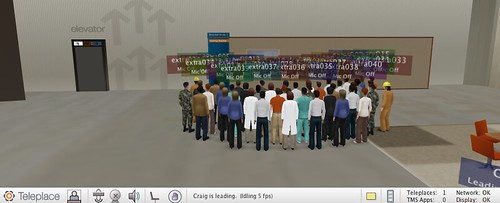
So far, actual users seem to have been most taken with the manifestation of this theme in the ability to control their colleagues.
I have never accused the incumbents of being overly subtle, especially when they feel threatened. But this new 14-page letter from the major cable and telco trade associations — as well as from the three biggest ILECs and Time Warner Cable (Comast shows unusual, perhaps merger inspired, diplomacy by sitting this one out) — hits a new low on the “Lack ‘O Subtlety Meter.” Given that the only one actively pushing reclassification these days has been yr hmbl obdn’t blogger, I should take this as a tribute to my personal skill. But it seems more likely an extension of the “shock and awe” tactics used by the incumbents to try to derail NN from the beginning.
Of course, this goes well beyond network neutrality. As AT&T’s previous lengthy exercises trying to justify Universal Service Fund reform under Title I (as well as AT&T’s less-than-direct acknowledgment that eliminating the phone network in favor of an IP-based network would eliminate interconnection requirements and complicate public safety access) attest, the question of FCC authority over broadband and what it can or can’t do under Title I impacts every area of the National Broadband Plan agenda.
Most of the argument in the letter is pretty standard, boiling down to “the universe is great under Title I dereg, don’t mess it up,” “Title II will impose horrible regulation, kill investment, destroy jobs, strangle puppies, etc.” with an additional “the FCC has no basis to change classification because nothing important has changed since the FCC reclassified last time.” Two things, however, require attention. Sadly, they mark the introduction by major players into the realm of “Tea Party” tactics similar to the Death Panels and mud slinging that have infected the health care debate and the financial reform debate.
More below . . .
We’ve discussed here how collaborative virtual worlds and other technology can be used to facilitate better business meetings while reducing business travel. (See here and its links.) What about when the Read More
Our David Smith has long had a vivid vision of ubiquitous computing that has complemented that of author Vernor Vinge. Here’s another step towards making that real.
If you do not have an account: Register
Inventing the Future
Situation Room
Real situation rooms devote an awful lot to physical requirements.
Here’s a virtual situation room from Forterra’s Olive platform, where there is lot more emphasis on dealing with the situation.
Of course, a real operations center needs to control and interact with the physical world, pulling in not just media, but also manifestations of live data. And the participants must be able to take actions that effect the real world. See an older video of a Teleplace network operations center doing that here.
If virtualization can produce an effective result for much less money, why not apply it in business as well as government? Here’s an example from industry analysts at Think Balm.
Physical situation rooms have costly recording equipment and people to operate them. This is an area where virtual situation rooms can not only be cheaper, but better because easier-to-use means more-likely-to-happen.
Of course, the point of a situation room is to bring experts and stakeholders together to deal with a changing situation. All the participants need to be able to quickly interact with resources, without physical or technological limitation. Unlike the set-in-concrete behemoths, a virtual environment can do better than bunkers to facilitate brainstorming and bringing new ideas together.